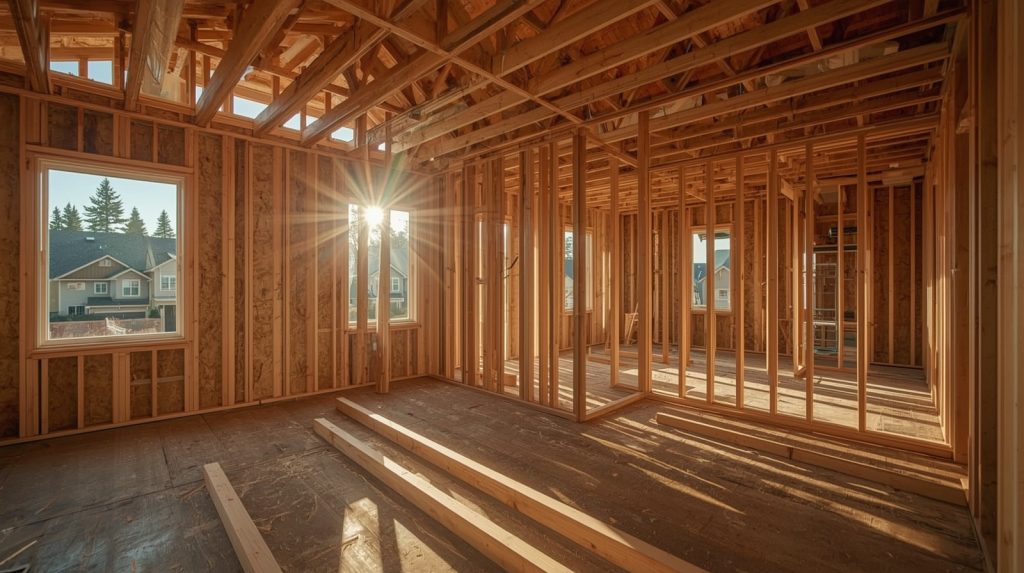

What Is Framing in Construction: The Complete Guide for Homeowners
Every building you have ever walked into — a house, a store, an office — started the same way. Before the drywall, before the paint, before the flooring and the fixtures, there was a skeleton. A carefully planned arrangement of boards, beams, and fasteners that gave the structure its shape, its strength, and its ability to stand for decades. That skeleton is called framing, and understanding how it works gives you a significant advantage whether you are building new, planning a remodel, or simply trying to make sense of what a contractor is telling you.
This guide explains framing in plain language — what it is, how it works, what the different systems are, and why the details matter more than most people realize.
What Framing Actually Is
Framing is the process of constructing the structural skeleton of a building. It is the step in construction where raw materials — most commonly dimensional lumber or steel — are cut, positioned, and fastened together to create the walls, floors, and roof structure that everything else in the building depends on.
Think of it the way you would think of the human skeleton. The finishes you see — siding, drywall, flooring, paint — are the skin. The mechanical systems running through the walls are the organs. But none of those things function or hold together without the bones underneath. Framing is those bones.
Beyond giving a building its shape, framing serves a precise engineering function. Every load that acts on a building — the weight of the roof, the snow that accumulates on it, the people and furniture inside, the pressure of wind against the walls — has to travel somewhere. Framing creates the path. Loads move from the roof down through the walls, through the floor system, and into the foundation, which distributes them into the ground. When framing is done correctly, that path is clear and continuous. When it is done poorly, loads find nowhere to go, and the building responds with cracks, squeaks, sagging floors, sticking doors, and eventually structural failure.
Framing also creates the cavities where everything else lives. The spaces between studs are where electricians run wire, plumbers route pipe, and HVAC crews install ductwork. A well-framed building gives those trades enough room to work without cutting through structural members. A poorly framed one creates problems that cascade through every trade that follows.
The Three Principles Every Framer Works By
No matter what system or material is being used, all framing comes back to three words: plumb, level, and square.
Plumb means perfectly vertical. A wall stud that leans even slightly will cause problems for every surface attached to it — the drywall will not sit flat, the trim will not align, and doors will not close properly. Level means perfectly horizontal. A floor joist that crowns slightly will cause a floor to bounce or squeak. Square means corners are at exact right angles. A room that is even a fraction of a degree out of square creates compounding problems for flooring, cabinetry, and tile work.
These three principles sound simple, but maintaining them across an entire structure — especially as the build progresses and conditions change — is what separates skilled framing from careless framing. Small errors at the framing stage do not stay small. They grow.
Platform Framing: Why It Became the Standard
The most common framing method used in residential construction today is platform framing, sometimes called western framing. The concept is straightforward. Each floor of a building is constructed as a complete, flat platform before the walls of the next floor are built on top of it. The floor deck of each level becomes the working surface for assembling the walls above.
This method became dominant for practical reasons. Workers have a solid, safe surface to stand on at every stage of the build. Materials can be staged on the deck without scaffolding. Walls can be assembled flat on the platform and then tilted up into position, which is faster and safer than building walls in place. And because each floor creates a natural fire break between levels, platform framing also performs better in fire situations than older methods.
The components are consistent. Bottom plates are fastened to the floor deck, studs run vertically between bottom and top plates, and a double top plate caps the wall and ties it to the structure above. Headers span door and window openings, transferring loads around the gaps. Cripple studs and jack studs fill out the framing around each opening. The repetition of this system is part of what makes it efficient — once a framing crew has a rhythm, they can raise walls quickly and accurately.
Balloon Framing: An Older Method Still Found in Existing Homes
Before platform framing became standard, balloon framing was widely used, particularly from the late 1800s through the mid-twentieth century. In balloon framing, wall studs run continuously from the foundation sill all the way to the roof line — sometimes twenty feet or more without interruption. Floor joists are carried on a ribbon board let into the face of the studs rather than sitting on a platform.
This method produces tall, open interior walls and is well suited to certain traditional architectural styles. If you own or are renovating an older home and notice extraordinarily long studs running the full height of a two-story wall, you are likely looking at balloon framing.
The challenges with balloon framing are real. Those long stud runs create continuous vertical channels in the wall cavity, which means fire can travel rapidly from floor to floor without interruption unless fire-stopping has been added. Long studs are also more difficult to source and handle. For these reasons, balloon framing is rarely used in new construction today, but understanding it matters if your project involves an older building.
Post-and-Beam and Timber Framing
Post-and-beam construction — and its traditional cousin, timber framing — takes a fundamentally different approach. Rather than relying on many small, closely spaced members to distribute loads, this system uses fewer, much larger members. Heavy posts carry vertical loads. Large beams span between posts horizontally. The structure carries loads through these primary members rather than spreading them across a field of studs and joists.
The appeal is both structural and aesthetic. Post-and-beam systems can span distances that would require multiple intermediate supports in conventional framing. They also create open, unobstructed interior spaces that many people find architecturally compelling. Exposed timber framing has a warmth and character that concealed light framing simply cannot replicate.
Traditional timber framing uses joinery — mortise-and-tenon connections, wooden pegs — rather than metal fasteners. Modern timber framing often incorporates steel plates and connectors that make assembly faster and more predictable. Both approaches require skilled work and careful planning. Timber is heavier to handle and more expensive to source than dimensional lumber, but for the right project, the results justify the investment.
Steel Framing: Light Gauge and Structural
Steel enters residential and commercial framing in two very different forms, and they serve different purposes.
Light-gauge steel framing uses cold-formed steel studs and tracks that function similarly to wood studs and plates. The material is thin — typically between 18 and 25 gauge — and is shaped into C-channels and U-channels that provide strength without excessive weight. It is fastened with self-drilling screws rather than nails. Light-gauge steel does not rot, warp, shrink, or attract insects, which makes it particularly well suited to humid climates and commercial construction where those factors are more significant.
Structural steel framing, by contrast, uses hot-rolled steel columns and beams — the heavy I-beams and wide-flange sections you associate with large commercial and industrial buildings. This system is capable of spanning enormous distances with minimal intermediate supports, which is why it dominates in warehouses, office buildings, retail spaces, and any structure requiring large open floor plans. Steel decking and concrete topping create the floor systems in these buildings. The connections — welded or bolted — are engineered to precise specifications.
The cost and complexity of structural steel make it impractical for typical residential construction, but for commercial tenant improvement projects and large additions, it opens possibilities that wood cannot match.
Engineered Wood: When Standard Lumber Is Not Enough
Modern construction increasingly relies on engineered wood products to handle situations where standard dimensional lumber falls short. These are manufactured products that use wood fiber in controlled, optimized ways to achieve predictable performance that natural wood cannot always provide.
I-joists are a common example. They use a structural composite lumber flange at the top and bottom connected by an oriented strand board web in the middle. The result is a floor joist that is stronger and stiffer than an equivalent piece of dimensional lumber, with far less tendency to shrink, warp, or crown. They are also lighter, which makes handling easier on site.
Laminated veneer lumber, known as LVL, bonds thin wood veneers together under heat and pressure with the grain aligned throughout. The result is a beam with consistent, predictable strength that can span distances and carry loads that would require an enormous solid timber to achieve. LVL beams are used extensively for headers over large openings, ridge beams, and anywhere a long, clean span is needed.
Roof and floor trusses take the engineered approach further by using the geometry of triangles — the strongest shape in structural engineering — to distribute loads efficiently across a lightweight framework. A well-designed truss can span the full width of a house without intermediate bearing walls, which gives architects and homeowners far more flexibility in the floor plan below.
The Components That Hold It All Together
Understanding framing means knowing what each individual component does and why it matters.
Studs are the vertical members in a wall, typically spaced 16 inches apart from center to center. They carry vertical loads from above and transfer them to the plates at top and bottom. In load-bearing walls, stud size and spacing are engineered to the load. In non-load-bearing partition walls, they exist primarily to provide a surface for drywall and to divide space.
Plates are the horizontal members at the top and bottom of each wall. The bottom plate is fastened to the floor deck or foundation. The top plate connects to the ceiling and floor framing above. A double top plate — two stacked members — is standard in most wall systems because it helps transfer loads from above and provides a wider surface for connections.
Headers are the beams that span door and window openings. When a stud is interrupted to create an opening, the load that stud would have carried needs to travel around the gap. The header carries that load horizontally to the jack studs on either side, which carry it down to the bottom plate. The size of a header — its depth and the material it is made from — is determined by the span of the opening and the load above it. Getting headers undersized is one of the most common framing errors in residential renovation work, and it shows up as sagging lintels and cracked drywall above openings.
Joists are the horizontal members that support floors and ceilings. They span between beams or bearing walls and carry the weight of everything on the floor above. Joist size and spacing are determined by span, load, and species. Blocking between joists at bearing points prevents them from rolling under load. Joist hangers provide clean, strong connections where joists meet beams at the same height rather than sitting on top.
Beams carry concentrated loads across spans and deliver them to posts or walls at their ends. They appear wherever joists need to change direction, where a floor opening requires support on multiple sides, and wherever a long clear span is required. A beam that is undersized deflects visibly under load and causes the floors it supports to feel soft and springy.
Sheathing — typically plywood or oriented strand board — is nailed to the face of stud walls and the top of roof rafters to create a continuous structural skin. This skin serves two purposes. It provides a nailing surface for exterior finishes and roofing materials. More importantly, it creates shear resistance — the ability of a wall to resist lateral forces like wind pressure and seismic movement. Without sheathing, a stud wall is strong against vertical loads but offers almost no resistance to horizontal pushing. The nail pattern that attaches sheathing to studs is not arbitrary — it is specified on the structural drawings and directly affects how much lateral force the wall can resist.
Metal connectors — hurricane ties, hold-downs, post caps, joist hangers, and anchor bolts — may seem like minor hardware, but they are critical to the system. They transfer specific forces at connections that nails and screws alone cannot handle reliably. In regions with significant wind or seismic exposure, these connectors are required by code and inspected before walls are closed. Missing or improperly installed connectors are invisible once drywall goes up, but their absence creates real vulnerability.
Load Paths: The Concept That Ties It All Together
Every decision in structural framing connects back to one concept: the load path. A load path is the route that forces take as they travel from where they act — the roof, the floors, the walls — down to the foundation and into the ground.
When a load path is clear and continuous, the structure performs as designed. Every member in the path is doing its job, forces are distributed as intended, and the building behaves predictably under all the loads it will encounter in its life.
When a load path is interrupted — by an undersized header, a missing post, an improper connection, or a stud removed during renovation without replacement support — the forces that member was handling have to go somewhere else. They deflect into adjacent members that may not be designed for the added load. Deflection increases. Connections work harder than they should. Over time, the symptoms appear: floors that bounce, cracks above door frames, doors that stick in their openings, walls that are no longer plumb.
Understanding load paths is why framing changes during renovation require more thought than they might appear to. Removing a wall, widening a door opening, or adding a floor penetration for a staircase all interrupt existing load paths. Each interruption requires a replacement path — new headers, new beams, new posts, or new connections — that carries the load around the change and delivers it safely to the foundation.
Remodel Framing: Where Experience Matters Most
New construction framing begins with a clean slate. The plans are clear, the materials are fresh, and the sequence is predictable. Remodel framing is a different discipline entirely.
In an existing building, you are working with conditions that were never documented or that have changed over time. Walls that look non-structural sometimes carry hidden loads. Framing members that were installed decades ago may not meet current code requirements for the loads they are carrying. Moisture damage, pest damage, and previous renovation work may have compromised members you cannot see until you open the wall.
The first rule of remodel framing is to understand what is carrying load before you remove anything. This sometimes requires temporary shoring — structural supports installed to hold loads in place while permanent framing is modified. Removing a load-bearing wall without proper shoring first is one of the most dangerous mistakes in renovation work, and it happens more often than it should.
Once existing conditions are understood, the work of creating new load paths begins. Openings get properly sized headers and jack stud support. Beams are added where walls are removed. Posts are added to carry beams to foundations. Connections are made at every point where forces transfer from one member to another. The goal is a modified structure that performs as well as or better than the original — and meets current code requirements.
Why Framing Quality Determines Everything That Follows
Framing is completed before most of what homeowners think of as their house even exists. By the time flooring, cabinets, tile, and paint are being installed, the frame is hidden behind layers of insulation, sheathing, and drywall. It is invisible. But it determines how every one of those finishes performs for the life of the building.
A floor framed with properly sized, correctly spaced, and well-secured joists will feel solid and quiet underfoot for fifty years. A floor framed carelessly — with joists that were not checked for crowning, blocking that was skipped, or connections that were not fully made — will announce itself every time someone walks across the room.
A wall framed plumb and true accepts drywall cleanly, holds paint flat, and aligns with every door and window it surrounds. A wall that was framed fast and carelessly forces every subsequent trade to compensate. Drywall finishers build up mud to cover gaps. Trim carpenters cope and scribe to work around surfaces that do not meet squarely. Tile setters add mortar to correct for floors that are not flat. Each compensation costs time and money, and some cannot be fully corrected no matter how much effort goes in after the fact.
This is why experienced contractors consistently place framing quality at the top of the list when evaluating what makes a project succeed or struggle. The frame is the one thing that cannot be easily revisited once the building is closed up. Getting it right the first time is not optional — it is the foundation on which everything else depends.