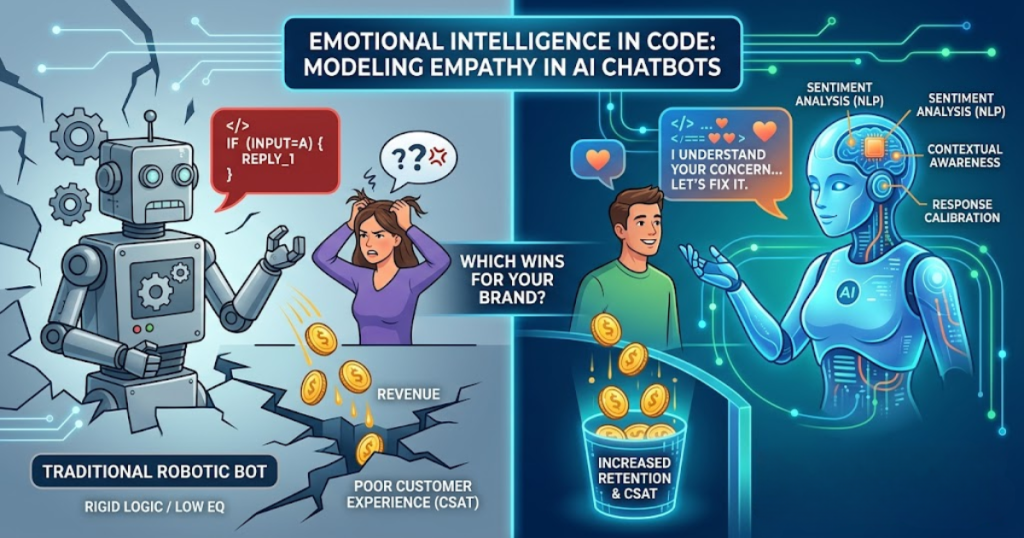

In the early days of automation, chatbots were rigid and robotic. They followed strict “if-then” logic. If a user deviated from the script, the bot failed. Today, the landscape has changed. Modern users demand more than just fast answers. They want to feel heard.
This shift has forced every leading AI Chatbot Development Company to rethink its strategy. We are moving away from simple data retrieval. We are moving toward “Emotional Intelligence” (EQ) in code.
The Core of Emotional Intelligence in AI
Emotional Intelligence in AI refers to the ability to detect, interpret, and respond to human emotions. It is not about the bot “feeling” anything. It is about the bot simulating a helpful and empathetic human response.
Technical experts focus on three main pillars:
- Sentiment Analysis: Identifying the user’s current mood.
- Contextual Awareness: Understanding the history of the interaction.
- Response Calibration: Adjusting the tone and vocabulary to match the user.
Technical Frameworks for Sentiment Analysis
A professional AI Chatbot Development Company does not guess how a user feels. It uses Natural Language Processing (NLP) to extract emotional signals.
Natural Language Understanding (NLU)
NLU goes beyond keywords. It looks at syntax and semantics. For example, the sentence “That is just great” can be positive or sarcastic.
Technical Methods:
- VADER (Valence Aware Dictionary and sEntiment Reasoner): This tool maps words to emotional intensities.
- Transformer Models: BERT and GPT architectures analyze the relationship between words in a sentence.
- Polarity Scoring: Assigning a value between -1.0 (very negative) and +1.0 (very positive) to every user input.
How Companies Model Empathy in Code
Building an empathetic bot requires more than a friendly greeting. It requires deep architectural choices. Here is how a Chatbot Development Company approaches the problem.
1. Dynamic Personality Mapping
Every bot needs a persona. However, that persona must be flexible. If a customer is angry about a billing error, a “bubbly” bot persona is frustrating.
Implementation:
- Tone Adjusters: The bot shifts from “Casual” to “Formal” based on sentiment scores.
- Empathy Templates: Developers create response libraries for specific emotional states like frustration, confusion, or joy.
2. Intent vs. Emotion
A bot must understand what the user wants and how they feel. If a user says, “I lost my credit card,” the intent is “Report Lost Card.” The emotion is “Panic.”
A standard bot only addresses the intent. An empathetic bot addresses both. It might start with, “I am so sorry to hear that. Let’s secure your account immediately.”
3. Memory and Continuity
Nothing kills empathy faster than a bot that forgets what you said two minutes ago. High-end AI Chatbot Development Company teams build “Session Persistence.”
Technical Tools:
- Redis or DynamoDB: Used to store short-term conversation context.
- Vector Databases: Used to retrieve long-term user preferences and history.
The Role of Large Language Models (LLMs)
The transition to LLMs has changed everything. Older bots used “Decision Trees.” Modern bots use “Probabilistic Reasoning.”
Chain of Thought Prompting
Developers use “Chain of Thought” techniques. This tells the AI to “think” about the emotional context before it generates a reply.
Example Prompt Logic:
- Analyze the user’s tone.
- Identify the core problem.
- Acknowledge the frustration.
- Provide the solution.
This structure ensures the empathy is not an afterthought. It is a core part of the calculation.
Statistics: The Business Case for Empathy
Why does an AI Chatbot Development Company invest so much in empathy? The numbers provide a clear answer.
- 71% of customers expect companies to deliver personalized interactions.
- 80% of customers are more likely to purchase from a brand that offers a personalized experience.
- Empathetic AI can increase customer satisfaction scores (CSAT) by up to 20%.
- Research shows that AI with high EQ can reduce customer churn by 15%.
These stats prove that empathy is not just a “nice to have” feature. It is a financial requirement in 2026.
Use Case: Empathy in Healthcare Bots
Healthcare is the most critical area for emotional intelligence. A patient asking about symptoms is often scared.
1. The Standard Bot
- User: “My chest hurts and I am scared.”
- Bot: “I found 5 articles on chest pain. Would you like to read them?”
2. The Empathetic Bot (Professional Development)
- User: “My chest hurts and I am scared.”
- Bot: “I understand this is a very worrying situation. Please stay calm. Are you having trouble breathing right now?”
The second response uses “Mirroring.” It acknowledges the fear. It then moves to a life-saving question. A Chatbot Development Company specializes in these high-stakes logic flows.
Overcoming Technical Challenges
Modeling empathy is difficult. Human language is full of nuance. Developers face several hurdles.
1. Detecting Sarcasm
Sarcasm is the “Final Boss” of sentiment analysis. “Wonderful service!” said after a three-hour wait is negative.
- Solution: Systems look for “Discrepancy Indicators.” They compare the positive words to the historical wait time.
2. Avoiding “The Uncanny Valley”
If a bot sounds too human, it becomes creepy. This is the Uncanny Valley.
- Solution: Developers ensure the bot identifies as an AI. It says, “As an AI assistant, I am sorry you are experiencing this.” This maintains a healthy boundary.
3. Multi-Language Empathy
Empathy looks different in every culture. Some cultures prefer directness. Others prefer soft language.
- Solution: Leading AI Chatbot Development Company firms use localized LLMs. These models understand cultural idioms and emotional norms.
Bridging the Gap with Human-in-the-Loop
Even the best AI has limits. Sometimes, a human must take over.
Sentiment-Based Handover
A key feature of professional Chatbot Development Company services is the “Sentiment Trigger.”
- If the sentiment score drops below -0.8, the bot stops talking.
- It immediately alerts a human agent.
- The human receives a summary of the bot’s emotional analysis.
This ensures that a customer never gets stuck in a loop with a machine when they are truly upset.
Data Privacy and Ethical Empathy
Collecting emotional data requires trust. Users must know their feelings are not being sold.
1. Anonymization
Technical teams ensure that sentiment data is anonymized. The system learns that “Frustration” occurred. It does not need to know “John Doe” was the one frustrated.
2. Bias Mitigation
AI can learn bad habits from human data. If it learns from rude conversations, it might become rude.
- The Technical Fix: Fine-tuning on “Gold Standard” datasets. These datasets contain only respectful and helpful interactions.
Conclusion
In 2026, the “Digital Factory” of AI is becoming more human. An AI Chatbot Development Company does more than just write code. It builds relationships.
Empathy in code is about precision. It is about using sentiment scores to choose the right word at the right time. It is about understanding that a customer is more than a ticket number.
By choosing a professional Chatbot Development Company, businesses ensure their AI tools are effective and kind. The technology is here. The data is clear. The companies that model empathy today will lead the markets of tomorrow. Empathy is no longer a human exclusive. It is the new standard for the digital world.