
Submental fat accumulation—commonly known as a double chin—is a multifactorial aesthetic concern influenced by genetics, aging, and weight distribution. This localized fat deposit is often resistant to lifestyle interventions, such as diet and exercise, leading to increased demand for non-surgical double-chin removal procedures.
Over the past decade, injectable deoxycholic acid—marketed as KYBELLA treatment—has been widely used for targeted fat dissolution. However, advancements in energy-based devices and minimally invasive technologies have expanded the range of Kybella alternatives, offering patients more tailored and, in some cases, more efficient treatment pathways.
This article provides an evidence-aligned evaluation of the best alternatives to Kybella, focusing on safety, mechanism of action, clinical outcomes, and practical application in modern aesthetic practice.
Understanding KYBELLA: Mechanism and Clinical Limitations
KYBELLA contains synthetic deoxycholic acid, a bile salt that facilitates fat emulsification. When injected into subcutaneous fat, it disrupts adipocyte membranes, leading to irreversible fat cell destruction followed by gradual metabolic clearance.
Established Clinical Considerations
- Typically requires multiple treatment sessions (2–6)
- Causes predictable post-injection inflammation, including swelling and tenderness
- Limited to localized fat reduction without skin tightening
- Outcomes depend heavily on injection technique and patient anatomy
While effective for appropriately selected patients, these limitations have accelerated interest in Kybella alternative treatments that may reduce downtime, improve contour precision, or address skin laxity simultaneously.
Evidence-Based Kybella Alternatives in 2026
1. Cryolipolysis (CoolSculpting)
Mechanism: Controlled cooling induces adipocyte apoptosis without damaging surrounding tissues.
Clinical Evidence:
Cryolipolysis is supported by multiple peer-reviewed studies demonstrating consistent submental fat reduction with a favorable safety profile.
Advantages:
- Completely non-invasive
- No anesthesia required
- Minimal recovery time
Limitations:
- Gradual results over 8–12 weeks
- Less effective for fibrous or dense fat deposits
Clinical Role: A primary option for patients seeking double chin removal without surgery and minimal downtime.
2. Radiofrequency (RF)–Based Fat Reduction
Mechanism: Thermal energy heats adipose tissue and stimulates collagen remodeling.
Clinical Relevance:
Devices using radiofrequency are widely used for combined fat reduction and skin tightening, addressing two major contributors to submental fullness.
Advantages:
- Improves skin laxity alongside fat reduction
- Controlled and customizable energy delivery
Limitations:
- Results depend on device type and operator expertise
- Multiple sessions are often required
Clinical Role: Particularly effective in patients with mild-to-moderate skin laxity.
3. High-Intensity Focused Ultrasound (HIFU)
Mechanism: Focused ultrasound energy targets deep tissue layers, inducing thermal coagulation and collagen stimulation.
Clinical Insights:
HIFU is primarily recognized for skin tightening, with secondary effects on fat reduction.
Advantages:
- Non-invasive with precise depth targeting
- Supports gradual contour improvement
Limitations:
- Fat reduction is less pronounced compared to other modalities
- Results develop over several months
Clinical Role: Best suited for patients where skin tightening is the primary concern rather than significant fat removal.
4. Laser-Assisted Lipolysis (Non-Invasive Systems)
Mechanism: Laser energy raises adipose tissue temperature, leading to fat cell disruption.
Advantages:
- Short treatment sessions
- Minimal discomfort
Limitations:
- Limited penetration depth
- Modest fat reduction compared to cryolipolysis or injectables
Clinical Role: Appropriate for mild cases of double chin fat reduction.
5. Alternative Injectable Lipolytics
Mechanism: Similar to deoxycholic acid, these compounds aim to disrupt adipocytes.
Important Clarification:
While various formulations exist globally, not all are approved across regulatory bodies. Clinical standardization and safety data may vary.
Advantages:
- Lower cost in some markets
- Comparable mechanism to KYBELLA
Limitations:
- Variable regulatory approval
- Inconsistent clinical evidence
Clinical Role: Should only be considered under qualified medical supervision with approved formulations.
Comparative Clinical Perspective
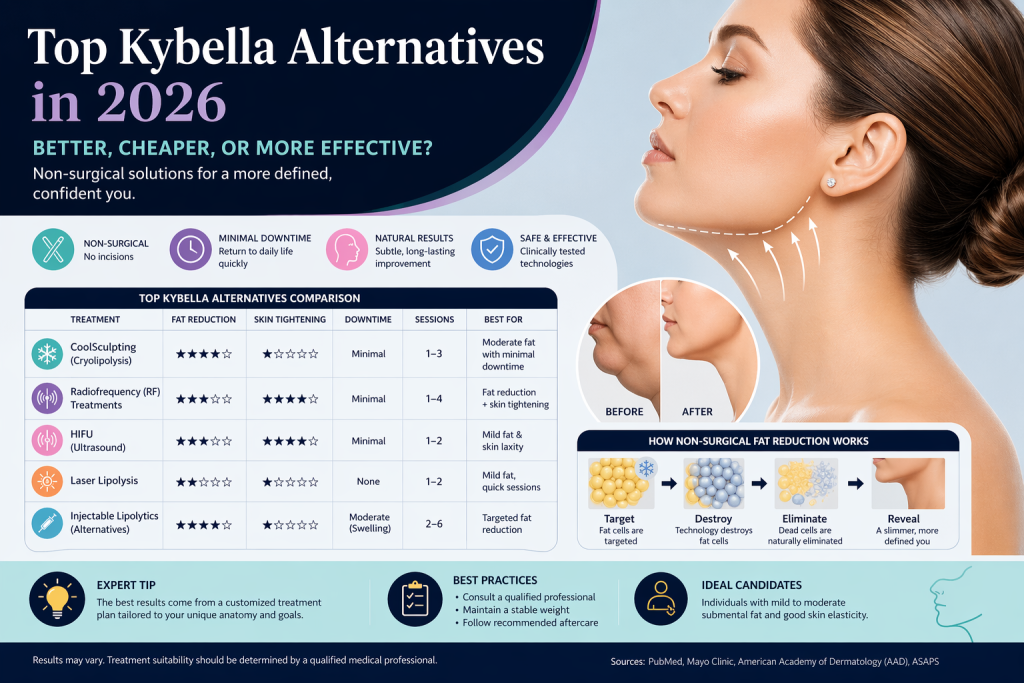
| Parameter | KYBELLA | Cryolipolysis | RF Treatments | HIFU | Laser Lipolysis |
| Invasiveness | Injectable | Non-invasive | Non-invasive/minimally invasive | Non-invasive | Non-invasive |
| Fat Reduction | High (localized) | Moderate | Moderate | Mild | Mild |
| Skin Tightening | No | No | Yes | Yes | Limited |
| Downtime | Moderate | Minimal | Minimal | Minimal | None |
| Sessions | Multiple | 1–3 | Multiple | 1–2 | 1–2 |
Expert Insights & Clinical Best Practices
1. Treatment Selection Must Be Anatomy-Driven
Clinicians assess:
- Submental fat volume
- Skin elasticity
- Mandibular definition
This ensures that chin fat removal treatments are appropriately matched to patient needs.
2. Combination Therapy Is the Standard of Care
Modern protocols frequently combine:
- Fat reduction modality (e.g., cryolipolysis or injectables)
- Skin tightening modality (e.g., RF or HIFU)
This integrated approach improves contour precision and long-term outcomes.
3. Gradual Results Are Clinically Normal
Fat metabolism and collagen remodeling occur over weeks to months. Immediate results are not physiologically expected with most non-surgical double-chin removal methods.
Common Misconceptions
“All fat reduction treatments deliver identical results.”
Different modalities target fat through distinct biological mechanisms, leading to varied outcomes.
“Skin tightening is automatic after fat loss.”
Fat reduction alone may accentuate skin laxity if not addressed separately.
“Non-surgical treatments replace surgery in all cases.”
Patients with significant fat volume or severe laxity may still require surgical intervention, such as submental liposuction or neck lift.
FAQ Section
1. What are the best double chin treatments in 2026?
The best double chin treatments 2026 include cryolipolysis, radiofrequency-based devices, and injectable lipolytics, depending on fat volume and skin condition.
2. Are Kybella alternatives effective?
Yes, many Kybella alternatives demonstrate clinically validated fat reduction, though effectiveness varies by technology and patient selection.
3. Which treatment works fastest?
Injectables may show earlier visible changes, while device-based treatments provide gradual improvement over weeks.
4. Is non-surgical double chin removal permanent?
Fat cells destroyed during treatment do not regenerate; however, remaining fat cells can enlarge with weight gain.
5. Do these treatments tighten skin?
Only certain technologies, such as RF and ultrasound, provide measurable skin tightening.
6. How many sessions are typically required?
Most treatments require between 1–4 sessions, depending on the modality and desired outcome.
7. Is there downtime?
Non-invasive treatments generally involve minimal to no downtime; injectables may cause temporary swelling.
8. Are results predictable?
Results are generally consistent when performed by qualified professionals, though individual variation exists.
9. Can treatments be combined safely?
Yes, combination therapy is widely used and considered best practice in aesthetic medicine.
10. Who is an ideal candidate?
Individuals with mild-to-moderate submental fat and good skin elasticity are typically the best candidates for double chin removal without surgery.
Conclusion
The evolution of Kybella alternatives in 2026 reflects a broader shift toward precision-based, patient-specific aesthetic care. While the KYBELLA treatment remains a clinically validated solution for targeted fat dissolution, emerging technologies provide expanded options that address both fat and skin quality.
Selecting the most appropriate Kybella alternative treatments requires a structured clinical assessment, understanding of device capabilities, and alignment with patient expectations. In modern practice, combination approaches that integrate fat reduction with skin tightening represent the most effective strategy for achieving natural, well-defined submental contours.
Ultimately, the effectiveness of any chin fat removal treatment depends not only on the technology used but also on proper patient selection, practitioner expertise, and adherence to evidence-based protocols.